AI Prompt Engineering Course: The Skills That Actually Matter
A good AI prompt engineering course teaches you to write complete briefs for an assistant, improve the answer in rounds, control style with examples and verify what comes back, and it makes you do this on real tasks, not toy ones. The word "engineering" sounds intimidating. In daily work it simply means being systematic about how you ask.
Below is the curriculum worth paying for, a few before-and-after examples, and how the first week of 28-Day AI Challenge from Promptia covers it.
The seven skills
1. Prompt anatomy
The backbone is four parts: role, context, task, format. Role sets the point of view ("You are a recruiter"). Context supplies facts the model cannot guess ("the role is remote, 20 applicants, three finalists"). Task says what to do ("compare the finalists"). Format says what you want back ("a table with strengths and risks, under 150 words").
Before: Help me with hiring.
After: You are a recruiter. I have three finalists for a remote customer-support role. Compare them on communication, tool experience and availability, using the notes below. Return a table with one line per criterion and a one-sentence recommendation.
2. Asking for questions first
A beginner trick with surprising power: tell the assistant to ask you three questions before answering. It surfaces the missing context. One of the day-1 starter prompts in 28-Day AI Challenge does exactly this.
3. Iteration
Plan on three rounds. Round one is the draft. Round two is specific edits ("cut the intro, make the tone warmer, add one concrete example"). Round three is polish and format. A course should drill this because the habit separates people who find AI useful from those who find it disappointing.
4. Role, tone and examples
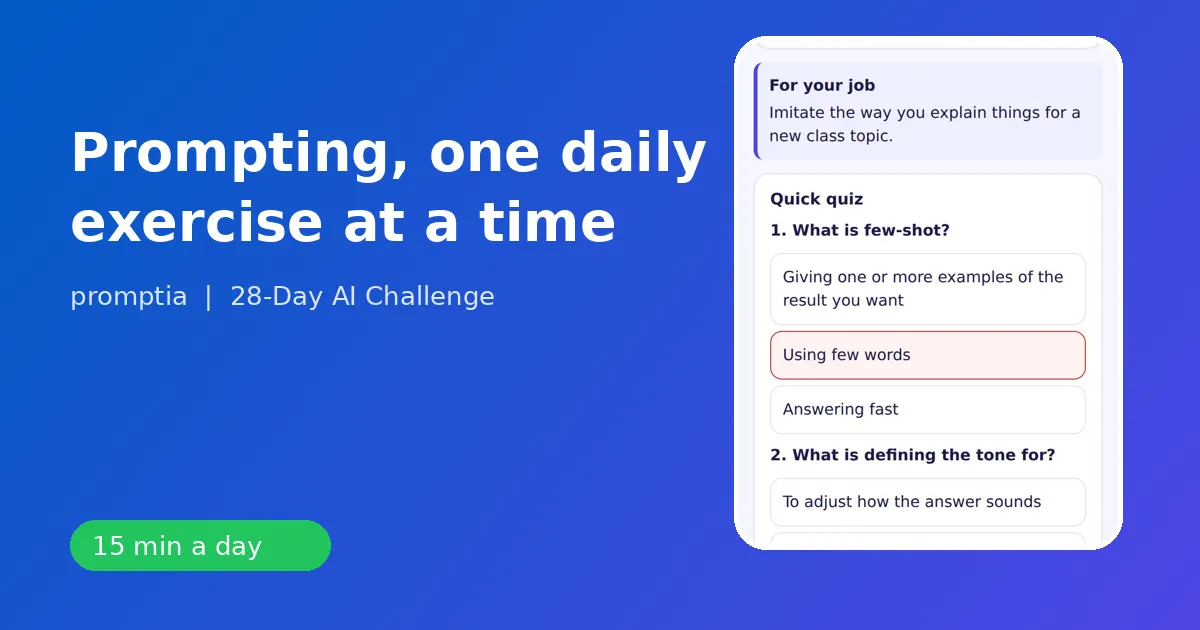
Showing beats telling. Paste two examples of the style you want and ask for a third in the same voice. This is often called few-shot prompting. It is how you get emails that sound like you, not like a brochure.
5. Summarize and extract
Long documents, long threads, long transcripts. The skill is asking for a specific output: five bullet points, the decisions made, open questions, names and dates in a table. Vague "summarize this" gets a vague summary.
6. Verification
Assistants invent citations, numbers and quotes. A serious course gives verification its own lesson: cross-check figures, ask for the source and then open it, and never forward unchecked output. In 28-Day AI Challenge that is day 6, right after the basics, because it should be a reflex from the start.
7. A prompt library
Your best prompts are assets. Save them with a name, the situation they fit and the placeholders to fill in. Day 7 of the challenge is entirely about building this library, so the first week ends with something you will use all year.
What a weak prompt course looks like
- A list of "100 magic prompts" to copy and paste. They work once, in someone else's context.
- Certificates of attendance with no exercises.
- Theory about model architecture that never reaches your keyboard.
- Promises that prompting alone will make you rich.
The first seven days, step by step
| Day | Lesson | What you produce |
|---|---|---|
| 1 | What generative AI is and how to talk to it | A first useful conversation about a real task |
| 2 | Anatomy of a good prompt | A prompt with role, context, task and format |
| 3 | Iterate in three rounds | The same answer refined step by step |
| 4 | Role, tone and examples | A text in a chosen voice using few-shot |
| 5 | Summarize and pull out what matters | A structured summary of a long text |
| 6 | Verify and avoid AI mistakes | A checked version of an answer with sources |
| 7 | My prompt library | Your reusable prompts, saved |
Each day takes 10 to 15 minutes. After you write the exercise prompt, you can paste it into the coach, which flags what is missing (no role, no format, too vague on context) and suggests a fix. The coach has a daily limit, so you use it where it matters.
Prompting differs by job
The lessons use the same structure but show different examples according to your role. A teacher might ask for a 20-minute lesson outline and then request a version for younger students. A designer asks for five concept ideas for an event poster. A technical person asks the assistant to explain a concept as if talking to a client. An entrepreneur asks for names for a service. You see why prompting skill transfers: the structure is constant, only the content changes.
Prompt patterns worth memorizing
The brief: role, context, task, format.
The interviewer: "Ask me three questions before you answer."
The editor: "Here is my draft. Do not rewrite it. List the five weakest sentences and say why."
The comparer: "Give me three options in a table: pros, cons, risk."
The checker: "List every factual claim in your answer and mark which ones I should verify."
Ten minutes with these five patterns will improve most people's results more than a long evening of tool exploration.
How long until it feels natural?
Expect a noticeable shift in the first week and fluency by the end of week two, if you write at least one complete prompt each day. The reason is simple repetition: by day 14 you will have written dozens of prompts, compared answers and corrected them.
Where prompting meets tools
Prompting is portable. The same brief works in ChatGPT, Claude and Gemini with small adjustments, which is why a course should teach structure first and tools second. If you want to understand how the behavior differs, read how to use Claude AI for real work. To see how feedback on your prompts can work, see what an AI coach does.
If you are starting from zero, the broader checklist in AI course for beginners will help you compare options. And when you are ready to choose software, the AI tools worth learning first narrows the field.
The goal of a prompt engineering course is simple: when you face a task, you know within a minute how to brief an assistant, how to improve the answer and how to confirm it is right. Everything else is decoration.
A quick self-test before you enroll anywhere
Open an assistant and give it this task with no help: Write a message to my landlord about a broken heater. Look at the answer. Now rewrite the prompt with a role, the facts (how long it has been broken, what you already tried), the task (ask for a repair date) and a format (polite, under 100 words, with a subject line). Compare the two results. If the second one is clearly better, you have felt the core of prompt engineering. A good course is a structured way to repeat that experience on every kind of task you face at work, until the brief takes you a minute and the result needs a light edit.